The short answer. For a manual gate on a flat opening, a swing gate is often the cheaper build: no track, no wheels, no foundation strip. Once you add a motor, a wide opening, a slope or a road-facing driveway, a sliding gate often comes out equal or better value — because one sliding motor replaces two swing arms and the groundwork suits the site. The real difference is decided by the factors below, not by the gate type alone.
We are not going to quote a price per gate in an article. Steel prices move, and two “3.5 m gates” can differ enormously in weight, design and site work. What we can do is show you what a fabricator is actually pricing, so you can compare quotes like for like.
1. Opening width and gate weight
Width drives almost everything. A wider gate needs heavier frame sections to stay straight, more infill, and — for sliding gates — a longer track and more clear wall to run back into. Weight matters as much as width: a dense slat or sheet-steel gate can weigh far more than a mesh gate of the same size, and a heavier gate needs heavier wheels, hinges and a stronger motor.
- Sliding: needs clear wall beside the opening roughly equal to the gate’s width, plus a little overlap.
- Swing: needs a clear arc inside the property for each leaf, and pillars strong enough to carry the leaves.
2. The infill design
The frame is only part of the steel. What fills it changes both material and labour:
- Mesh — light and quick to fabricate. ClearVu-style high-security mesh uses heavier welded wire with small openings, so it weighs and costs more than standard mesh, but you keep the view out.
- Horizontal or diagonal slats — more steel and many more welds; gives privacy and a modern look.
- Laser-cut panels — sheet steel plus cutting time. Busy patterns and large panels add cost; they are the most personal option.

3. Groundwork and the site itself
This is where quotes most often differ — and where cheap quotes cut corners.
- Sliding gates need a level concrete strip for the track across the opening and along the run-back. On a sloping driveway that strip has to be cut in or built up.
- Swing gates need the ground inside the opening to be level or falling away; if the drive rises behind the gate, the leaves will hit it. Pillars must be solid enough for hinge fixings.
- Rocky or clay ground changes footing work for posts, catches and motor bases.
If one quote is much cheaper than another, ask whether it includes the track foundation and who pours it.
4. Automation
A sliding gate uses one motor and a rack. A double-leaf swing gate normally needs two motor arms plus a control box — more hardware for the same opening. Both should include a battery backup so the gate still opens during a power cut, and we recommend safety beams on any automated gate that closes across a driveway. We supply and fit Centurion and equivalent motors (see gates & automation), and can often automate an existing gate if it runs true.
5. Finish and corrosion protection
Every gate we build is primed against corrosion. Galvanising and powder-coating cost more up front but hold up longer under Botswana sun and summer storms. When comparing quotes, check that each one includes the same finish.
Sliding or swing: which suits your property?
Choose sliding when…
- the driveway opens straight onto a road
- you want the full driveway free for parking
- the opening is wide (roughly 3.5 m and up)
- you plan to automate
- you have enough straight wall beside the opening
Choose swing when…
- there is no wall space for a sliding gate to run back
- the opening is narrower and will stay manual
- the ground inside is level or falls away
- you want a classic double-leaf look
- the leaves can open inwards without blocking cars
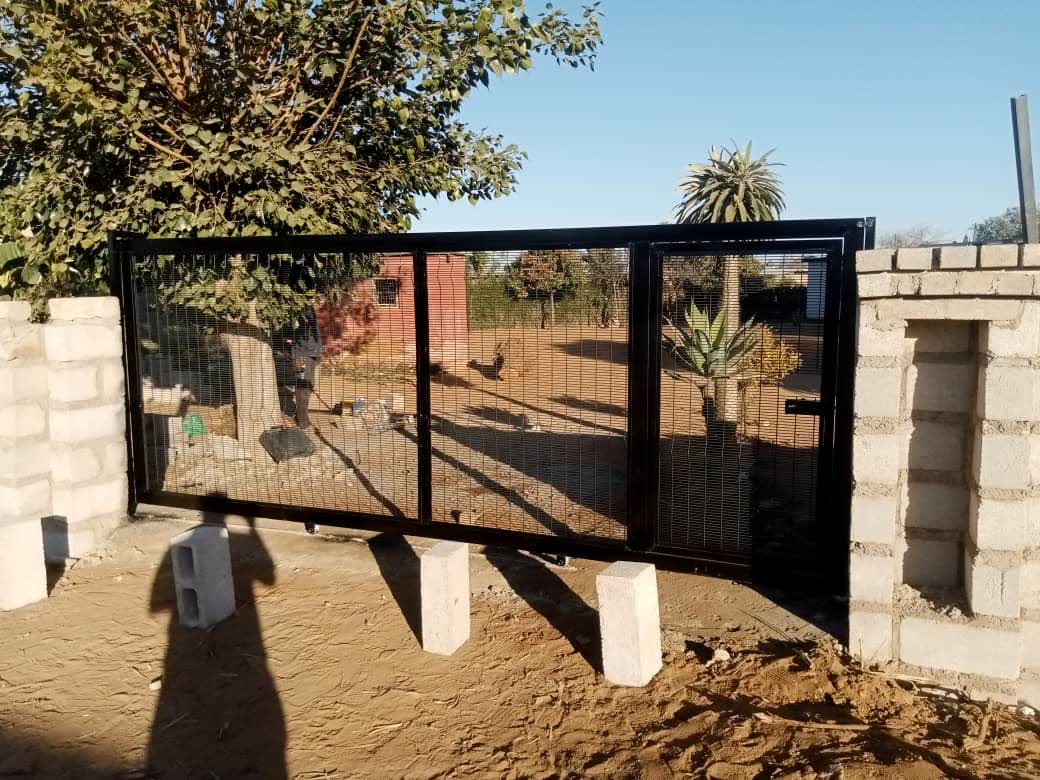
How to get an accurate quote quickly
- Measure the clear width between pillars and the height you want.
- Photograph the opening straight on, both pillars, and the ground on both sides.
- Say which way a sliding gate could run, or which way swing leaves could open.
- Tell us whether you want a motor and where the nearest power is.
- Send a picture of a design you like — from our gallery or anywhere else.
Building from scratch? Read our notes for new builds in Mmopane — the same advice applies anywhere: plan the track foundation and motor cable before paving. For road-facing rental plots, see Mogoditshane.
Want a price for your own site? Send the opening width, a photo straight on, your suburb and whether you want a motor. WhatsApp +267 75 388 737 — we reply within 4 business hours, and the site measure is free anywhere in Greater Gaborone.