What we do. We supply razor wire, make the brackets that carry it and install the whole system on boundary walls, palisade and mesh fences, gate tops and building edges. The brackets are welded in our own workshop to suit your wall width and fence posts, so the wire sits where it should and stays tight for years instead of sagging or being pulled off. Still deciding what to put on your wall? Read our razor wire vs electric fence guide for Botswana first. Adding razor wire to a new fence? See ClearVu-style & palisade fencing for per-metre and gate + fence quotes.
Most razor wire problems we are called out to fix are bracket problems: thin brackets that bend, brackets fixed into loose plaster, coils tied straight to the wall with no line wires, or wire that leans over a neighbour’s yard. Getting the steel right underneath the wire is the part we specialise in.
Types of razor wire we install
Concertina razor wire (coils)
Spiral coils of barbed tape on a high-tensile core wire, clipped so they open like a concertina along the wall. Coils come in several diameters; a larger coil is harder to reach across and looks more imposing, a smaller one is neater on a domestic wall. Single coils suit most homes. A double-coil setup on a Y-bracket, or a coil stacked inside a coil, is used where the risk is higher, such as yards, warehouses and long rear boundaries.
Flat wrap razor wire
Flat wrap is razor wire that has been pressed into flat panels, so it lies in one plane along the top or face of a wall or fence instead of standing up as a coil. It is lower-profile and tidier on a street front, and it is useful where a full coil would overhang a footpath or a neighbouring property.
Straight razor line and barbed tape
Straight strands of razor tape or barbed wire are run between brackets as line wires, on their own as a light deterrent or as the support lines that concertina coils are clipped to.
We use galvanised razor wire as standard for Botswana’s conditions. Stainless steel blade options can be quoted where you want the longest life.
Custom-made razor wire brackets
Off-the-shelf brackets come in a few fixed sizes and are often too light. Because we fabricate, we make brackets to suit the actual wall or fence, in the size and number the job needs.
Y-brackets
A Y-bracket stands on the centre of the wall and opens into two arms, one leaning in and one leaning out. Line wires run along each arm, and a concertina coil sits in the “V” between them. Y-brackets are the usual choice on a boundary wall where both sides need protection, or for double-coil security.
L-brackets and angled (cranked) brackets
An L-bracket or cranked bracket rises from the wall or post and then angles outwards, usually towards the side you want to defend. It carries coils or line wires out over the outer face, which makes the top harder to reach with a ladder or blanket. We set the angle so the wire stays on your side of the boundary line.
Wall-top brackets and upright brackets
Straight upright brackets bolted to the top of the wall raise the wire above the coping. They are the simplest option for a single coil or for flat wrap, and they can be made to step up and down with a wall that changes height.
Fence-post, palisade and gate brackets
For palisade and ClearVu-style mesh fences we make brackets that bolt or weld onto the existing posts, so the razor wire lines up with the fence. Gate-top brackets keep coils clear of the gate track and of anyone using a pedestrian gate. Corner and end brackets are heavier, because they take the tension of the line wires.
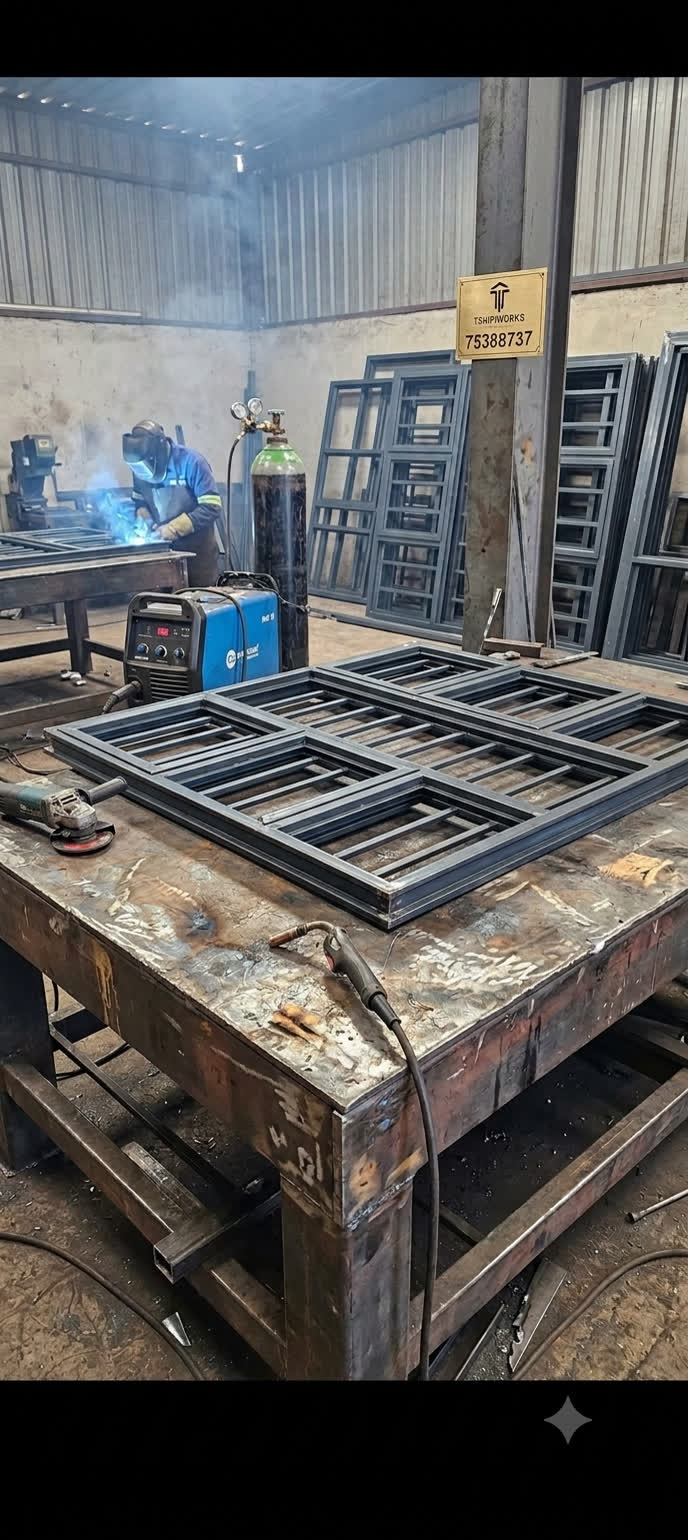
How we build and fix the brackets
- Steel sections are chosen for the span and the coil size. Typically we use angle iron, flat bar or square tube, with welded joints, never just bent rod.
- Spacing is set to the coil and the line wire tension, with closer spacing at corners, ends and where the wall steps.
- Fixing goes into sound brick, block or concrete with anchor bolts, or the brackets are welded or bolted to steel posts. We don’t fix into loose plaster or crumbling coping. If the wall top is weak we will tell you before quoting.
- Finish: every bracket is primed and painted, or galvanised on request, so rust doesn’t stain the wall.
- Line wires and clips: high-tensile line wires run along the brackets, and the coil is clipped to them so it cannot simply be lifted off.
Working with an existing electric fence
Many walls in Gaborone already carry an electric fence. We can design brackets that keep razor wire clear of the live strands, or that sit alongside the electric fence brackets. The electric fence itself (energiser, wiring and alarm connection) should be handled by a qualified electric fence installer. For the pros and cons of each, read our guide razor wire vs electric fence in Botswana.
Why custom fabrication matters for razor wire
- It fits the wall you actually have. Walls around Greater Gaborone vary in width, height and coping. Brackets made to measure sit flat and square.
- Heavier steel stays straight. A thin bracket can be bent down with a blanket or a pole. A welded bracket in a proper section stands up to that.
- It matches the rest of the property. We can paint brackets to match your gate, palisade or slat fencing.
- Repairs are local. If a coil is damaged or a bracket is hit, our workshop is in Gabane, not in another country.
Safety and responsible use
Razor wire is designed to injure, so it has to be installed with care. This is general guidance, not legal advice:
- Keep the wire on your side of the boundary. It should not overhang a neighbour’s yard, a public footpath or the road reserve.
- Mount it high enough that people, children and animals cannot touch it by accident from the ground, and away from gates people walk through.
- Consider warning signs so visitors and service workers know it is there.
- If you rent, live in an estate or complex, or are unsure, check with your landlord, body corporate or local authority before installing. Some estates have their own rules on wall-top security.
- Installation needs cut-resistant gloves, eye protection and the right tools. We handle the whole job, including taking away offcuts.
Homes, businesses and sites
We install razor wire for houses and rental yards, as well as shops, warehouses, schools, clinics and construction sites across Gaborone (including Gaborone West, Broadhurst and the CBD), Gabane, Mogoditshane, Tlokweng and Phakalane. For contractor and tender work priced from a BOQ, see commercial and tender fabrication.
How the job works
- Send the basics on WhatsApp. Send photos of the wall or fence, the approximate length in metres, the wall height, and whether you want coils, flat wrap or both. Tell us if there is an existing electric fence.
- Free site measure in Greater Gaborone. We measure the wall width, height and condition, mark corners and steps, and check what the brackets can be fixed into. The visit is free across Gaborone and Phakalane, Gabane, Mogoditshane, Tlokweng and Mmopane. Further afield in Botswana we quote from photos and measurements first.
- Written, itemised quote within 4 business hours of having the measurements. Every line is listed (material, sizes, finish, installation), so you can compare quotes properly.
- Fabrication in our Gabane workshop. Everything steel is cut, welded, ground, primed and painted at our workshop in Rasoko Ward, Gabane.
- Installation by our own team, then a walk-through at handover so you know how locks, latches and fixings work.
Need razor wire or brackets? WhatsApp +267 75 388 737 with photos, the length and your suburb. We also make brackets on their own if you already have the wire.